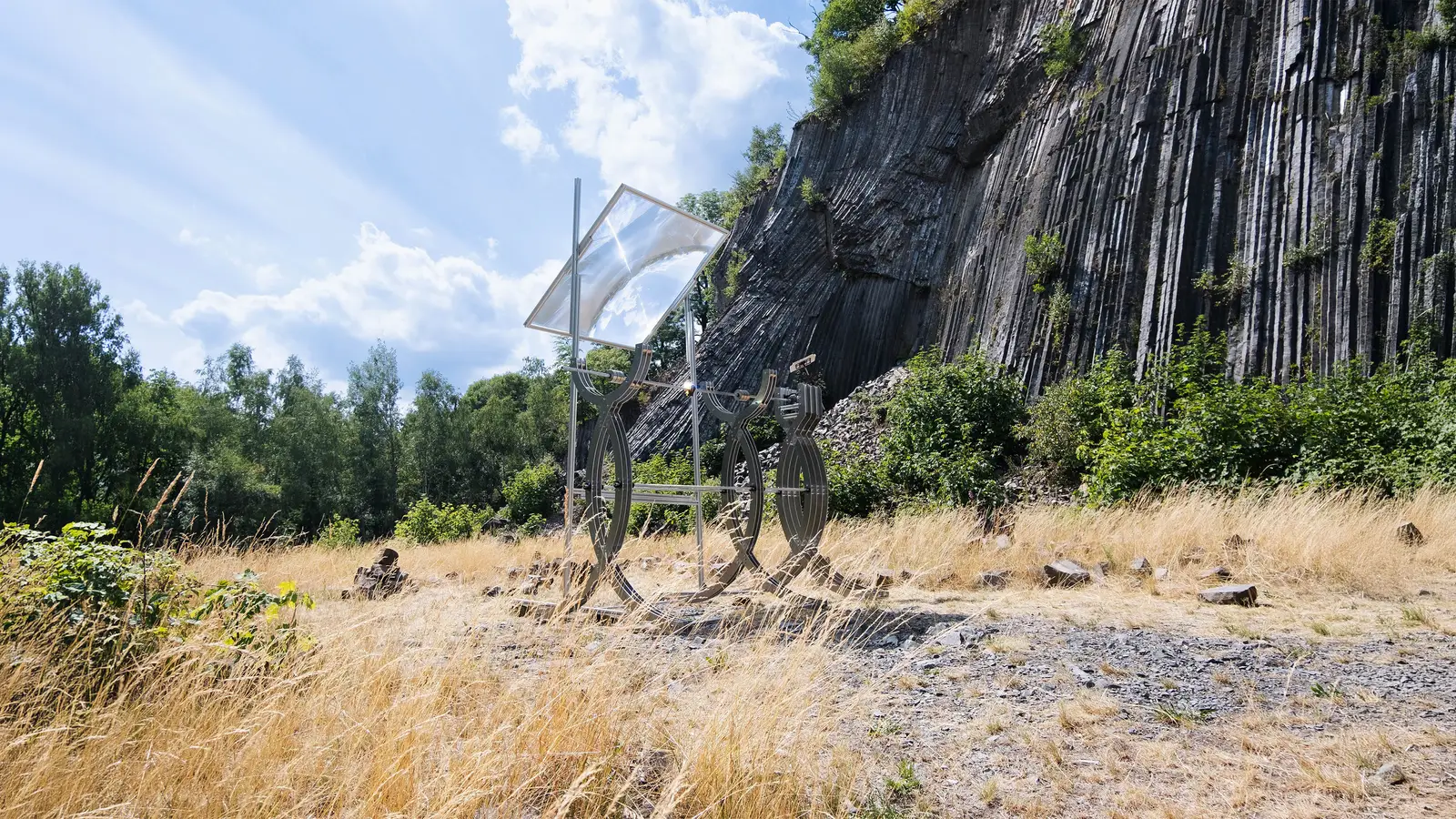
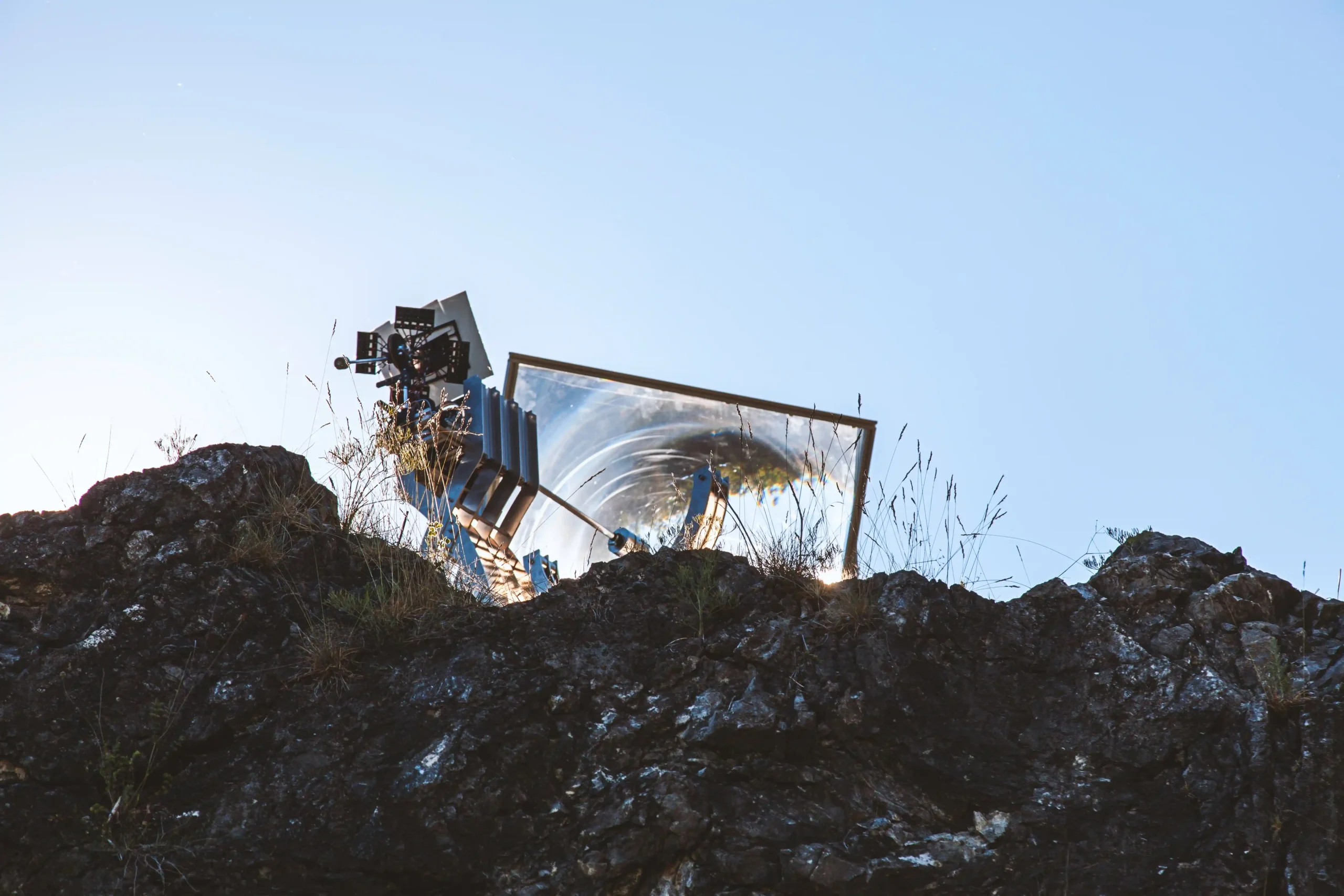
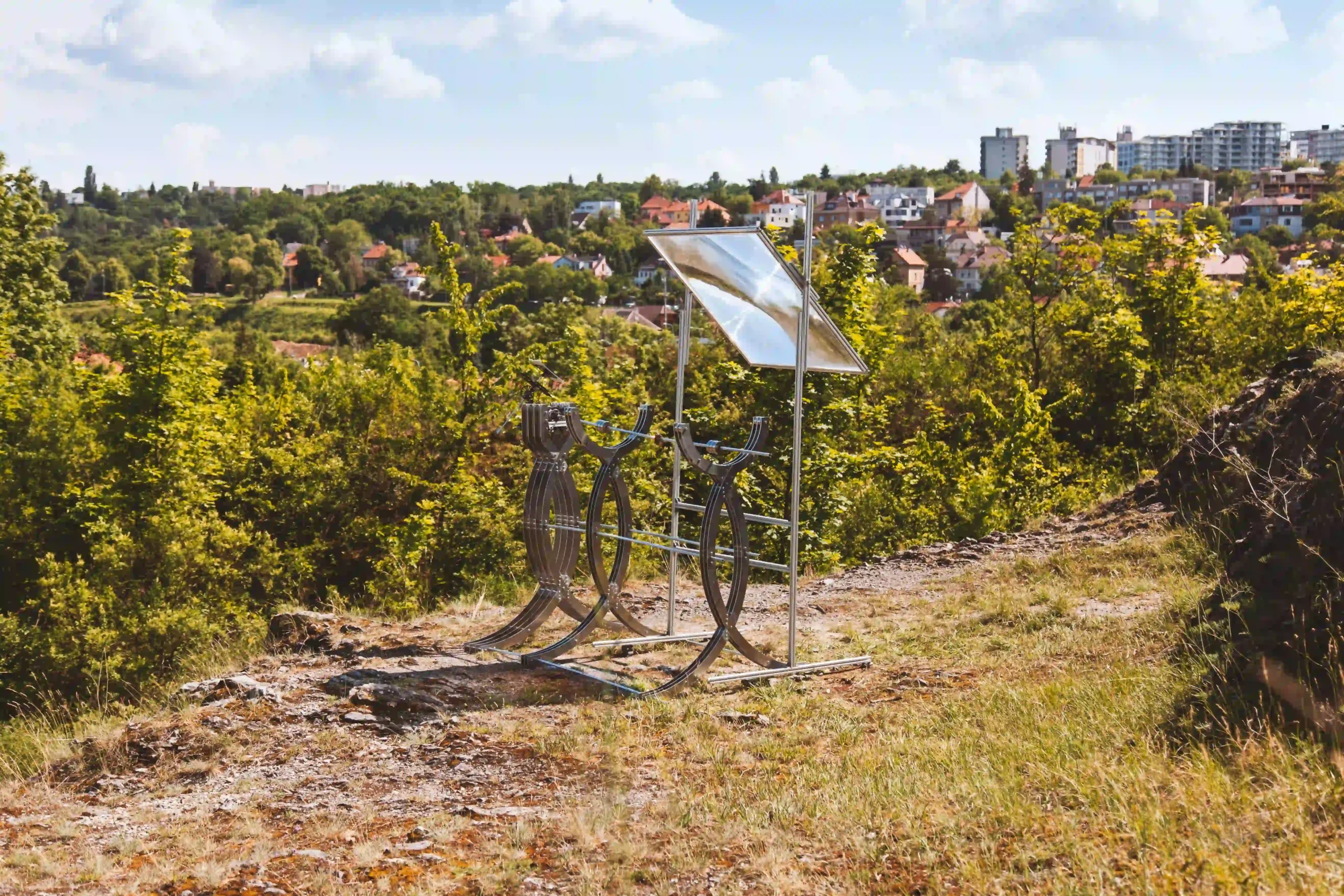
Generative video object. Combined aluminum profiles (3030 series), SBC units, translucent display, generative video.. Rendering: High-performance workstation with CUDA acceleration. Playback: Raspberry Pi 4B. Result is a continuous projection of water micro-world.
Entropic Futures Engine v1.0 (custom patch in TouchDesigner). Climate model datasets (ÚFA AV ČR) as input for fluid simulations (GLSL). Result is a prerendered video recording played in loop.
Hardware
Rendering: High-performance workstation with CUDA acceleration. Playback: Raspberry Pi 4B.
Data source
Climate models (CMIP6 ensemble) provided by the Institute of Physics and Atmosphere CAS, focused on predictions of temperature anomalies and extreme events.
Interaction
Contemplative. The viewer is a witness to the playback of a fixed recording of an algorithmic projection of the future.
The installation maps the transformation of water resources through a hybrid union of data analysis and ephemeral artistic representation. In line with Kryštof Brůha’s methods, this is not a matter of documentation, but of a fluid dialogue between a natural phenomenon and its technological interpretation. Through luminous, sonic, and graphic objects, it creates a polyphony of perspectives: from the depletion of groundwater to unexpected biodiversity in arid regions. „Water is not a problem, but a syntax,“ Brůha notes—each data point becomes a notation within a score that oscillates between decline and regeneration.
At the core of the installation lies a pair of interconnected objects. 2100 translates European Commission watercourse mapping data into video drawings, in which an algorithm simulates the bleeding of digital ink displayed on a translucent display. This process evokes both slow erosion and the spontaneous formation of river deltas. The data outputs subsequently feed the adjacent object, Fluctus, which converts these visual dynamics into audio frequencies that vibrate the surface of the water in the tank—“here, data pulsates like a subterranean spring that breaks through rock while simultaneously shaping it.“
This symbiosis is complemented by a series of six drawings created by a robotic arm. Calibrated errors in its movements mimic the unpredictability of natural processes: the density of the black ink reflects the extent of changes in the landscape, while blank areas suggest the paradox of stability. „Even the desert harbors a liquid memory,“ Brůha points out—dry valleys were once rivers, just as the black pigment can be a trace of vanished moisture.
The glowing yellow light enveloping the installation functions as an ambivalent metaphor, recalling both life-sustaining sunlight and fire destroying ecosystems. It does not appeal to catastrophism, but rather reveals the dual role of human intervention—technology as an instrument of both destruction and understanding. The sound, modulated by the water’s surface—which never repeats itself—reminds us: „any attempt to capture nature is merely a reflection on the surface—we see our own face, distorted by ripples of our own making.“ Thus, the installation refrains from judgment, offering instead a liquid archive: fragments of reality that will endure only until the next draining of the tank or the disintegration of the pigment.