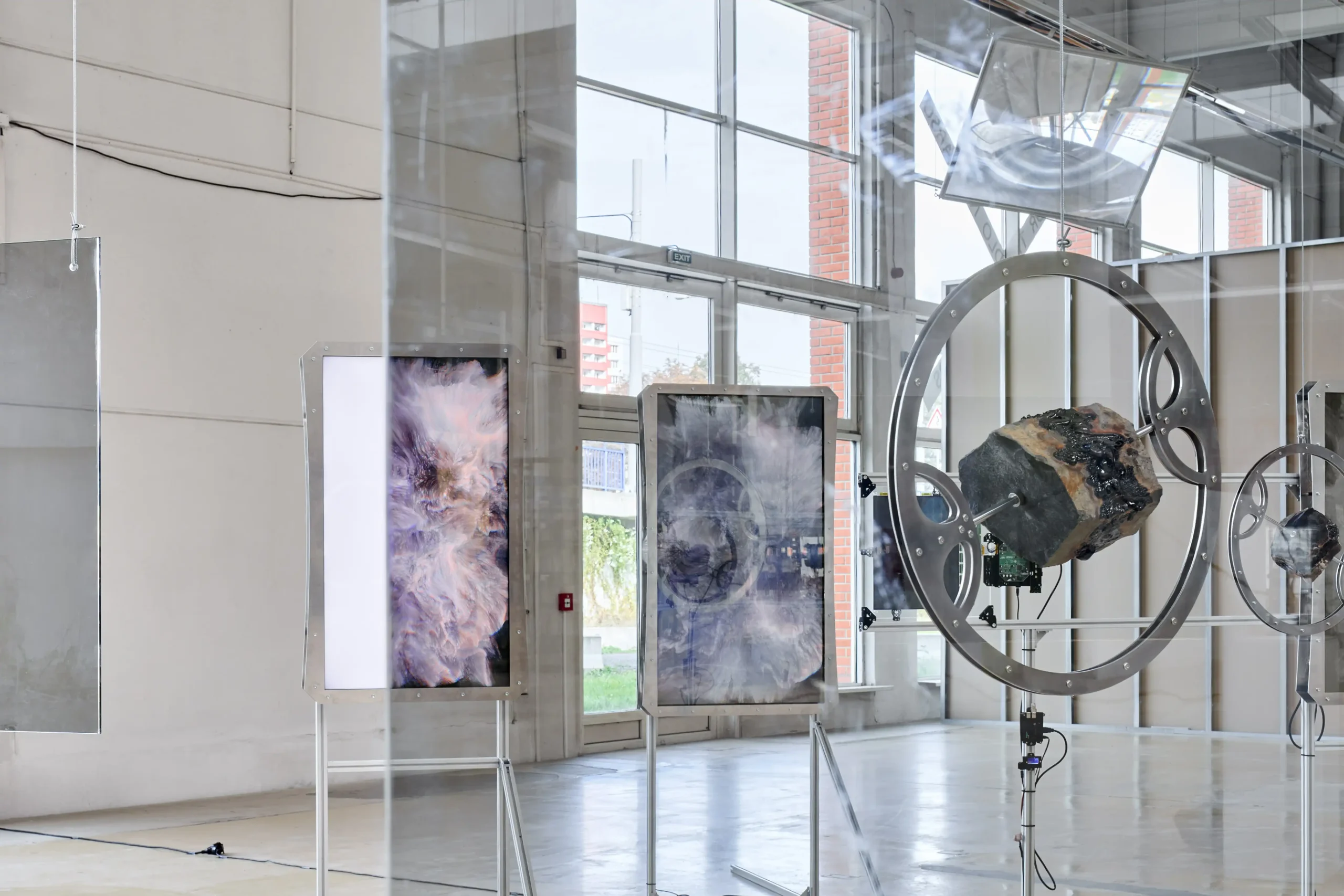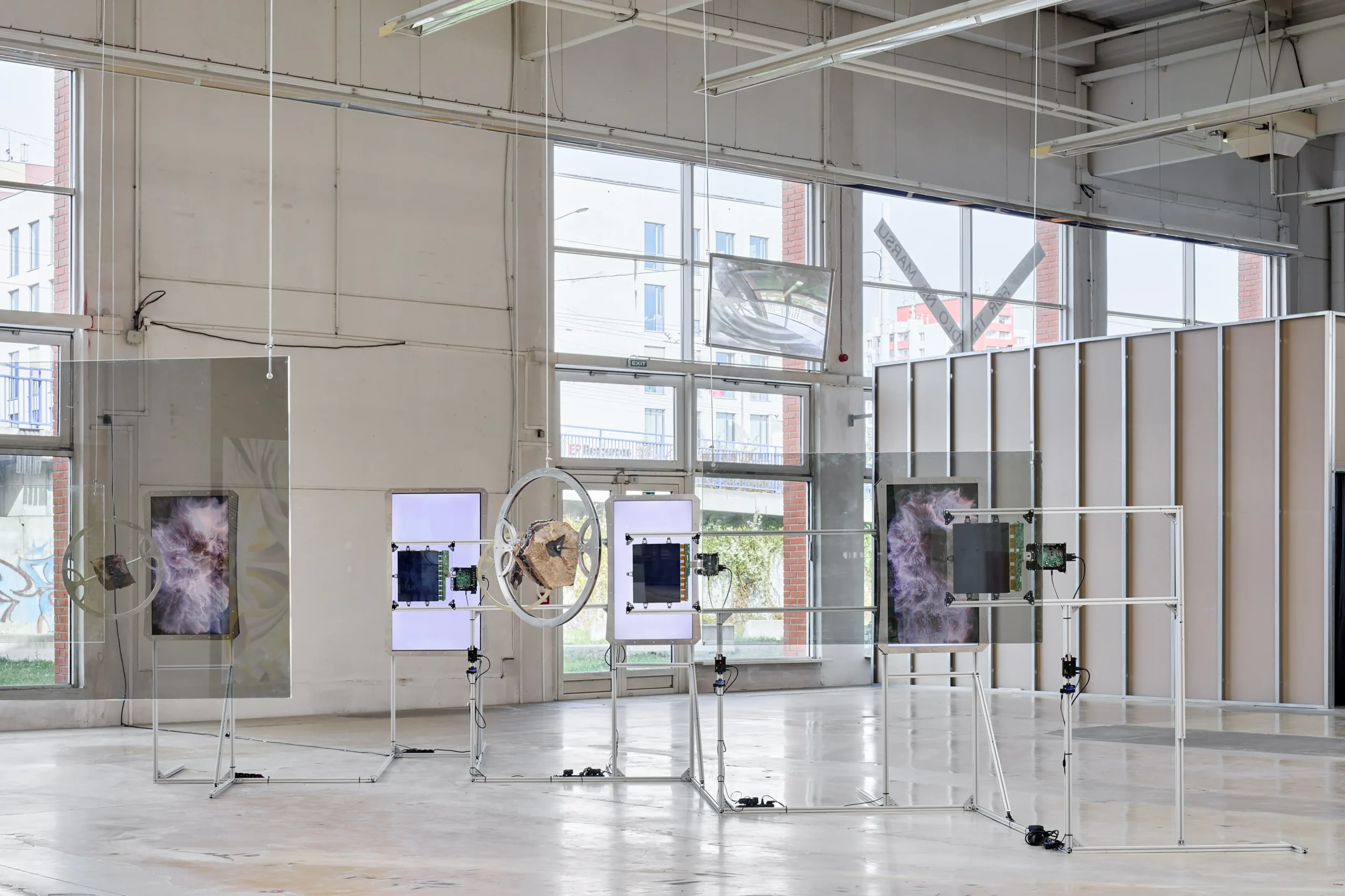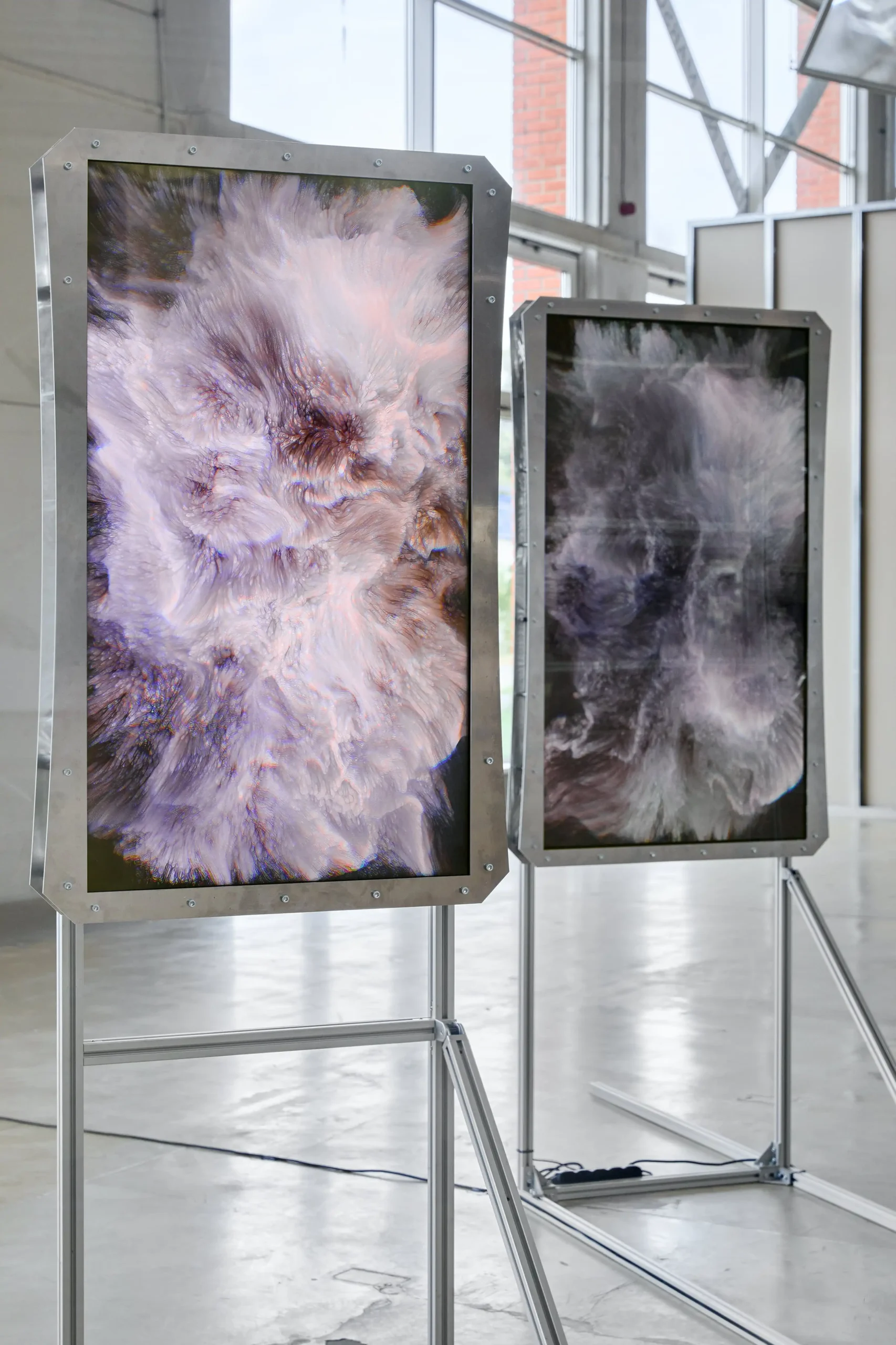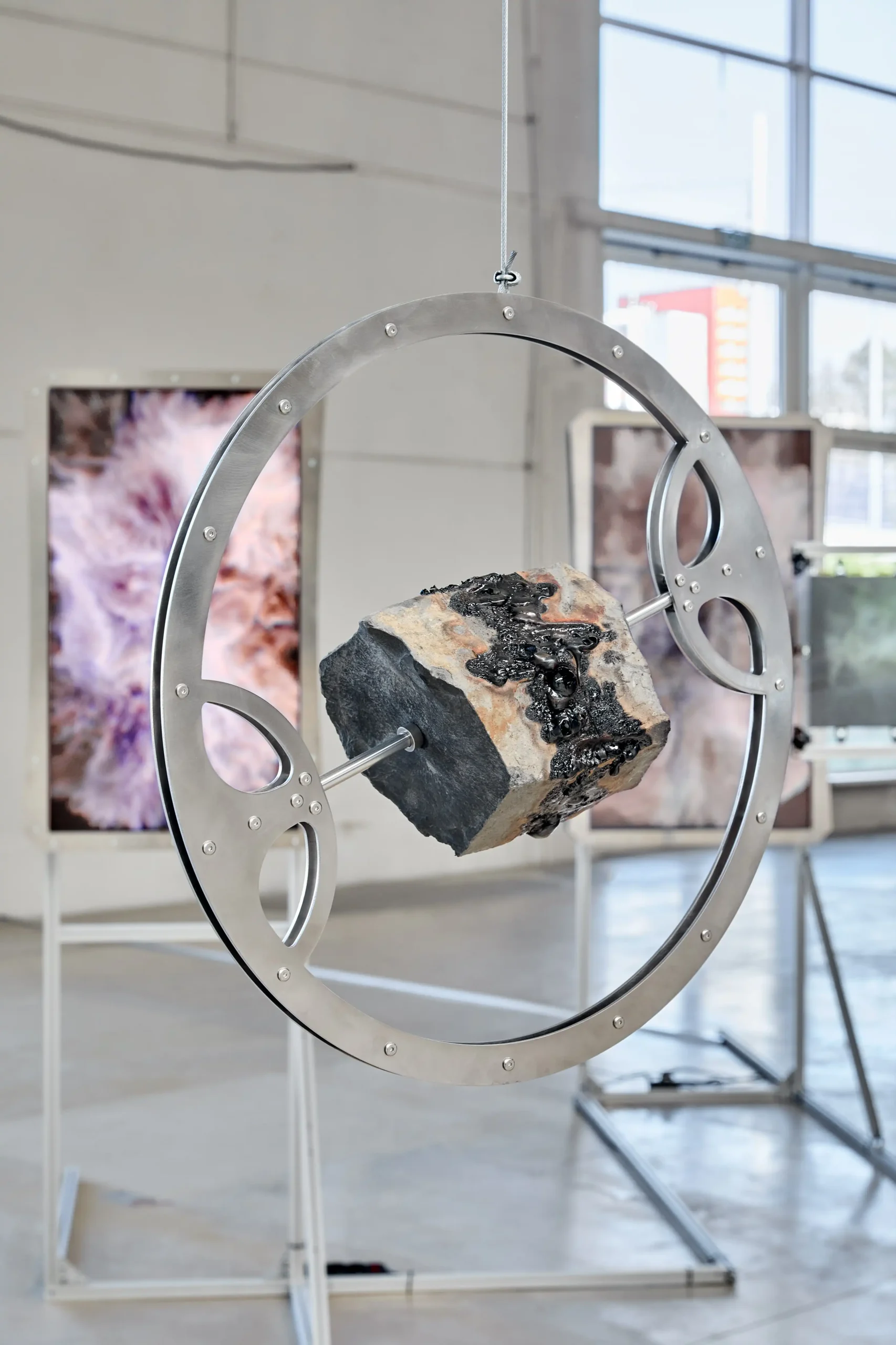
Multi-component, processual installation. Aluminium structures, modified transparent LCD panels, SBC units, custom polarizing filters on glass, basalt rocks transformed by concentrated solar energy (Inter Solaris method), neodymium magnets, Fresnel lens.. Fleet of Raspberry Pi 4B. Modified LCD panels without rear polarizing layer. Custom translucent displays. Neodymium magnets N52. Solar concentrator with 1.5m Fresnel lens. Result is a continuous projection of water micro-world.
| Series | Magna Mutatio |
| ID | 2023-MM-AUM-01 |
| Date of origin | 1.11.2023 |
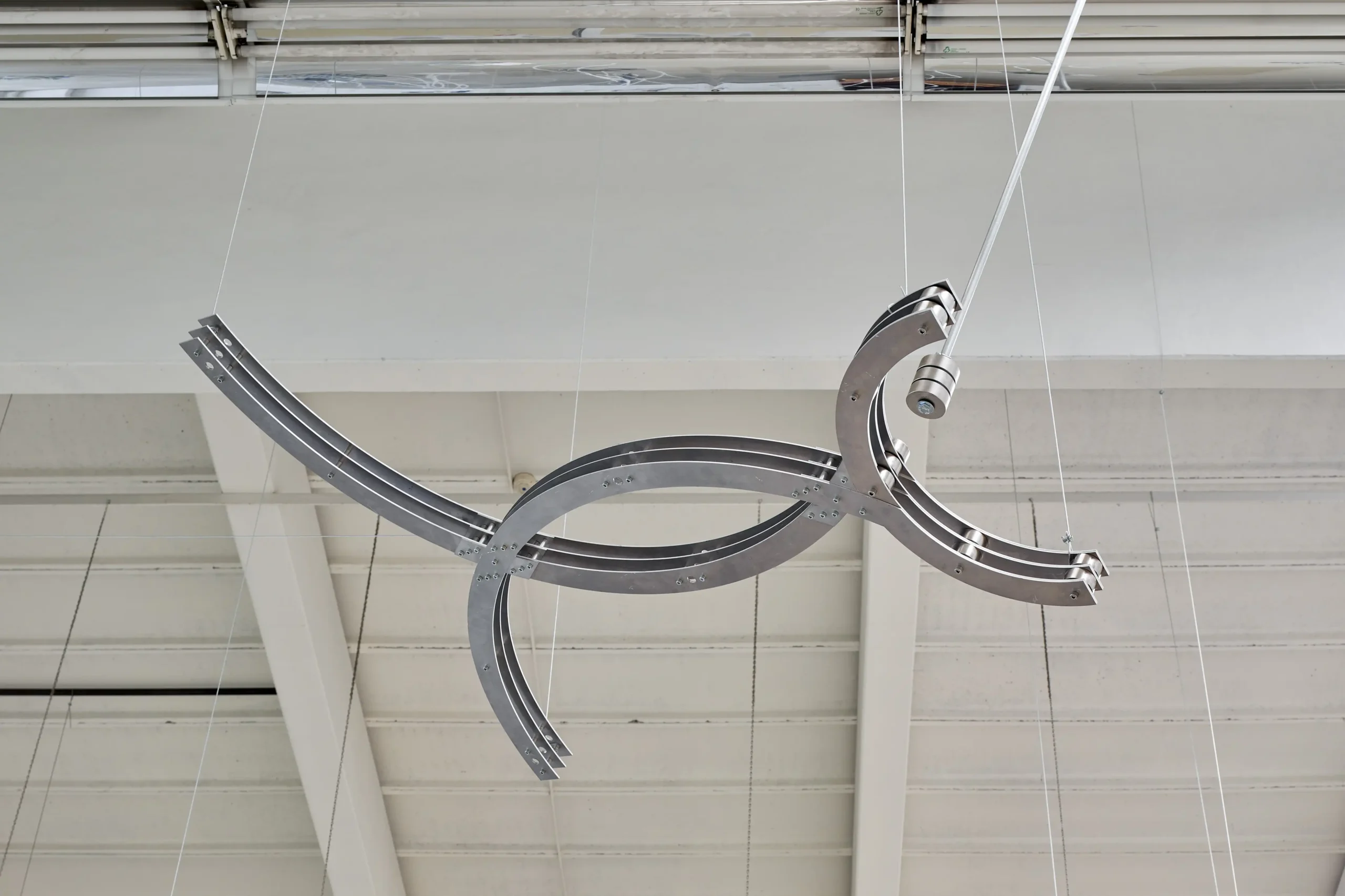
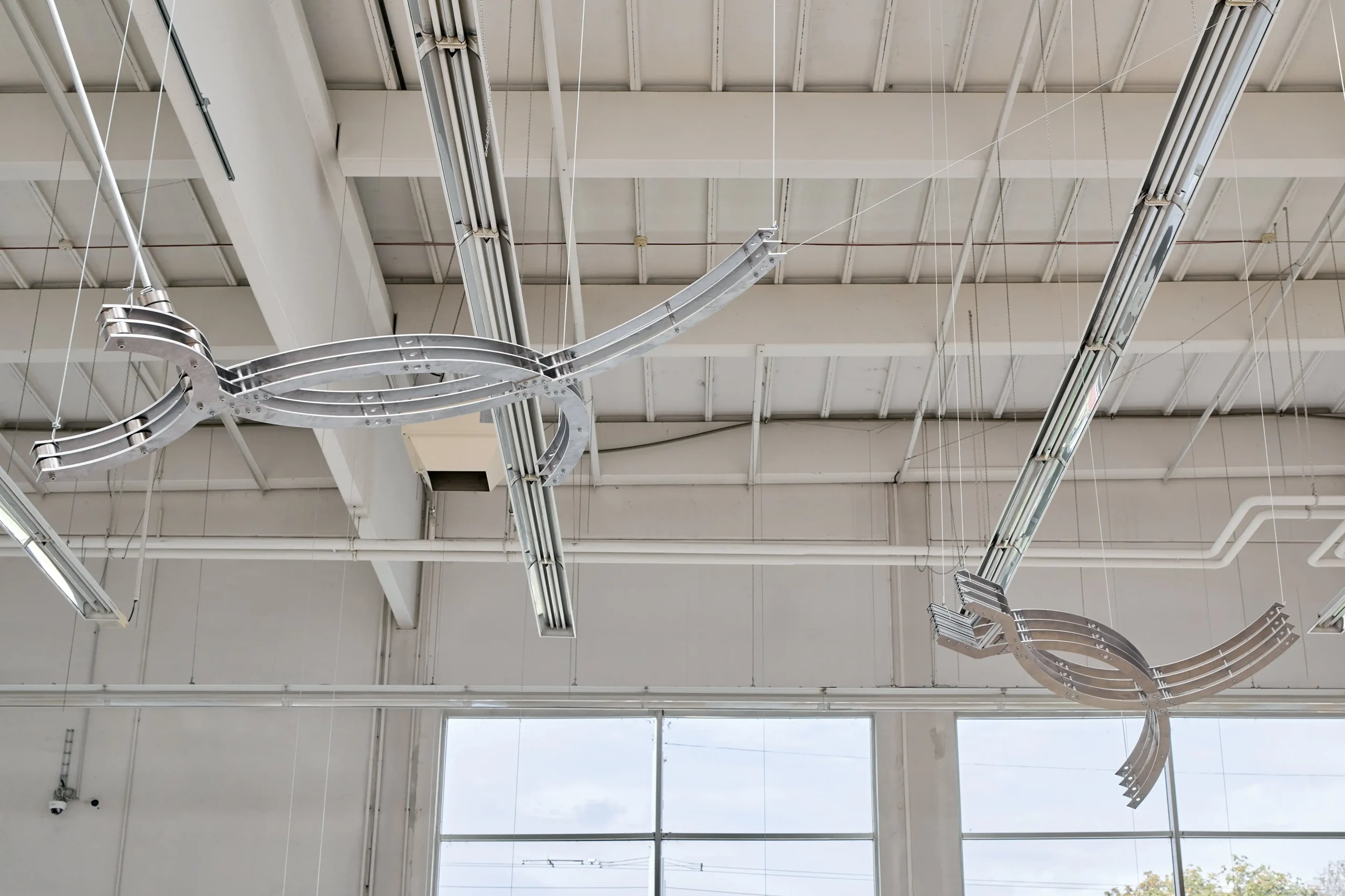
| Technique | Multi-component, processual installation. Aluminium structures, modified transparent LCD panels, SBC units, custom polarizing filters on glass, basalt rocks transformed by concentrated solar energy (Inter Solaris method), neodymium magnets, Fresnel lens. |
| Dimensions | Site-specific, approx. 2000 × 1000 × 700 cm |
| Duration | Generative video (continuous loop), static objects |
| Software | Archival Synthesis Engine v2.0 (custom TouchDesigner patch). Synthesis of two archival data streams: 1) Historical satellite thermal data (SOL-ARCHIVE CHRONOS-7 archive). 2) Telemetry logs from Inter Solaris performance. |
| Hardware | Fleet of Raspberry Pi 4B. Modified LCD panels without rear polarizing layer. Custom translucent displays. Neodymium magnets N52. Solar concentrator with 1.5m Fresnel lens. |
| Data source | Multi-source: 1) Land surface temperature data (LST) from MODIS radiometer (NASA) — Zlatý Vrch location. 2) ESA Sentinel-2 satellite data (displayed through polarizing filter). 3) Physical rock samples with thermally recorded information. |
| Interaction | Cognitive and mediated. The viewer must actively use the polarizing filter as a tool to unlock a hidden layer of visual information. |
| Location of origin | Jindřich Chalupecký Award 2023 Exhibition / Plato Bauhaus / Ostrava / Czech Republic |
| Type of exhibition | Gallery installation |
| Curator | Barbora Ciprová |
| Photo | Jan Kolský |
| Author of text | Ruda Minka (critical text) |
| Key concepts | Hyperobject, mediated perception, data archaeology, thermal visualization, multi-scalarity, cognitive tool |
| Text title | Magna Mutatio / Aurei Montis: Interface for Hyperobject |
| Date | Exhibition |
| 1.11.2023 | Jindřich Chalupecký Award 2023 – PLATO Ostrava |
| Series | Related works |
| Inter Solaris | Inter Solaris (2019) — rocks from performance as physical artifacts |
| Aurei Montis | Aurei Montis – Expositio Invisibilis (2025) — direct successor — AI version |
| Magna Mutatio | Magna Mutatio – Aeris Chronos (2025) — sibling — polarizing filters as cognitive tool |
CONCEPT
Neither in its visuality nor its materiality does Brůha’s work align directly with the crises of the contemporary human world—at least, not in an immediate sense. Instead, it steps outside of them to explore other limits. In his installation for PLATO Ostrava, presented as part of this year’s Jindřich Chalupecký Award, he weaves several of his long-term series (Magna Mutatio, Inter Solaris, and Aurei Montis, respectively) into a single, entangled configuration. On this occasion, he applies his methods to examine the geologically unique site of Zlatý Vrch (Golden Hill) in northern Bohemia.
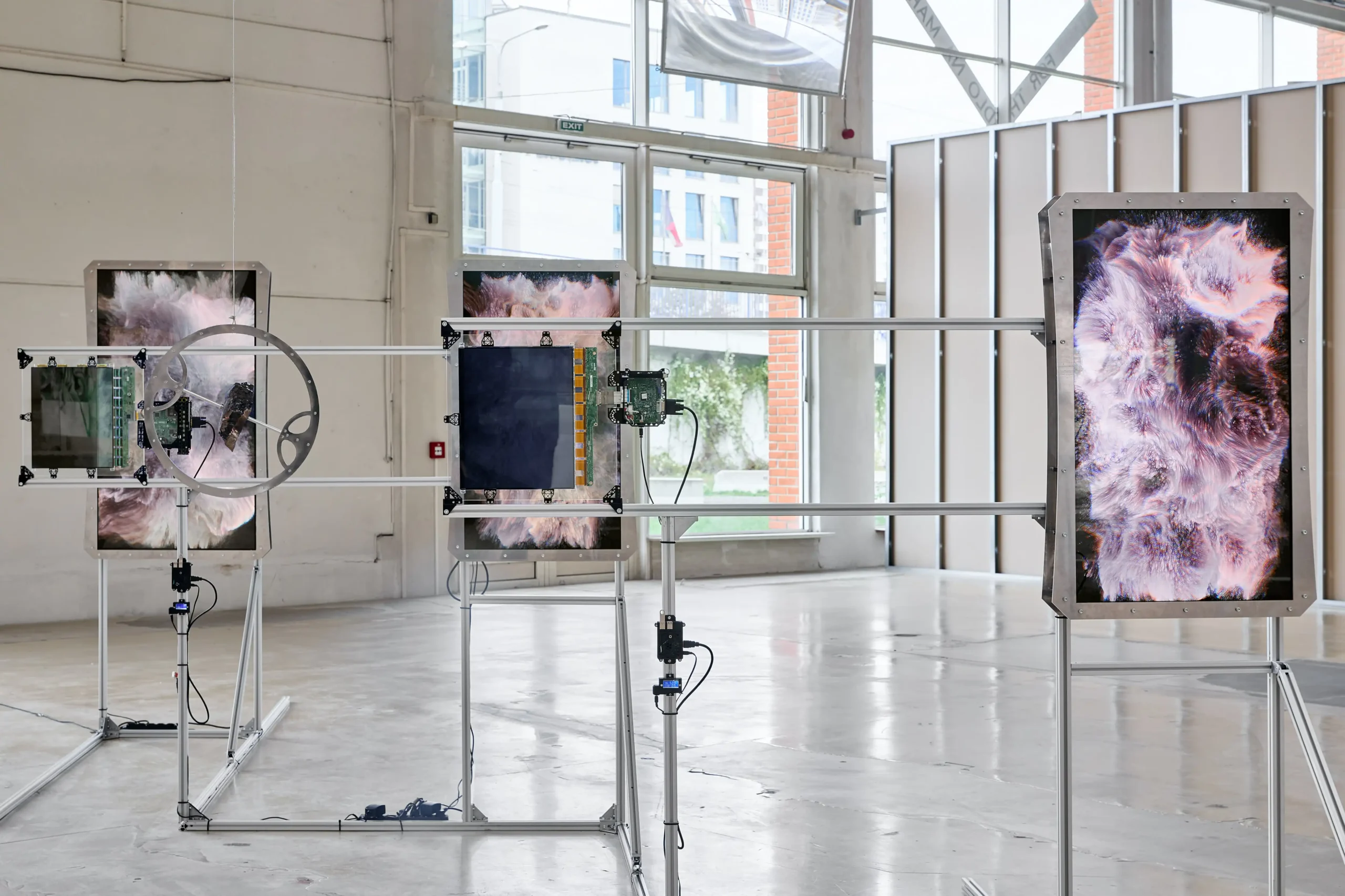
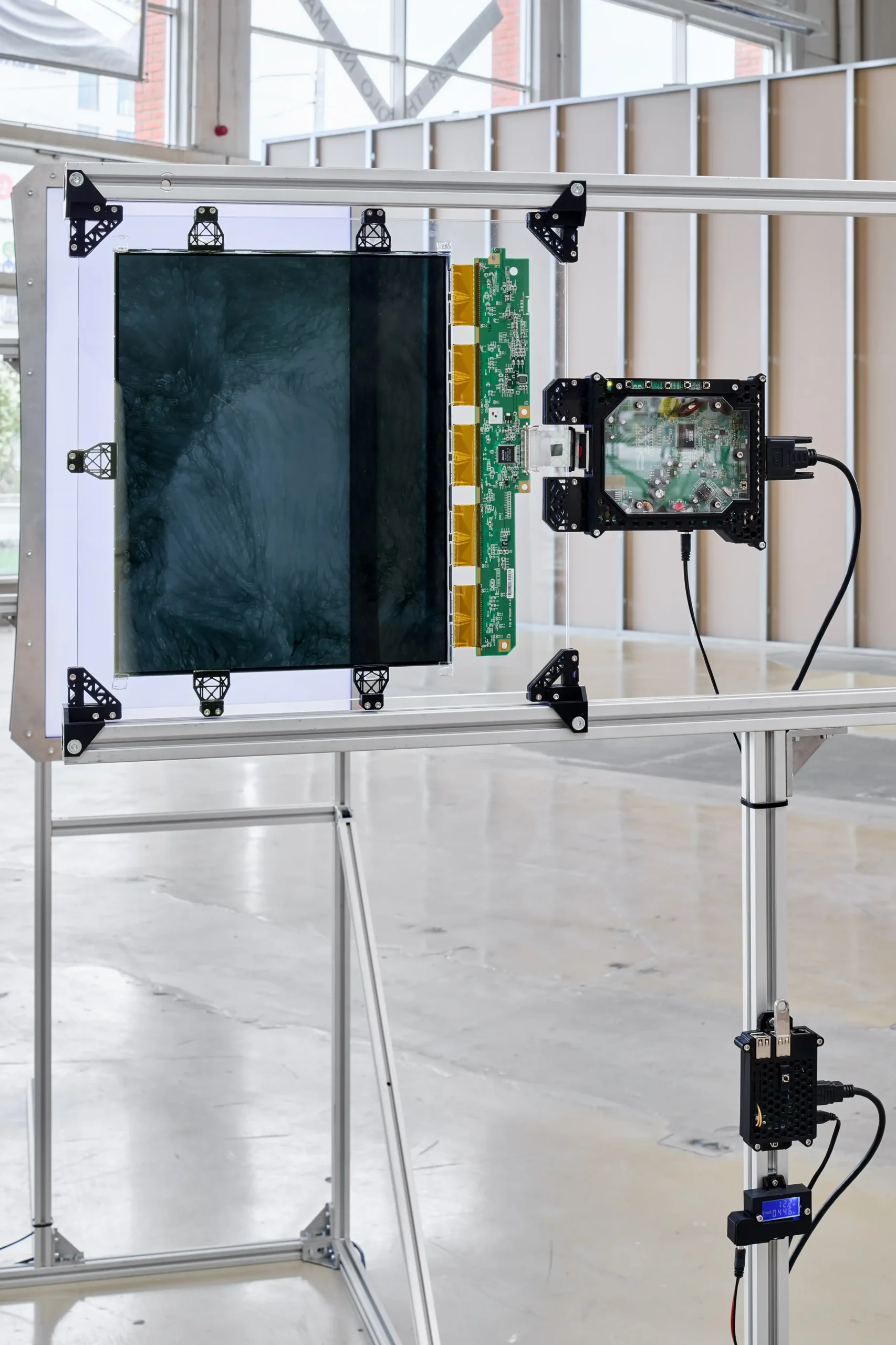
In the installation, he primarily works with phenomena that are otherwise imperceptible to the human eye. The first part consists of individual aluminum structures featuring integrated transparent displays powered by an exposed motherboard with visible cabling—the flows of information—rendering present an element normally hidden from sight. What flows across the displays is a visual in-between state—or rather, a state we cannot clearly define: barely identifiable maps. Automated projections mapping discharges, tremors, nodes, and loops—captured and recorded by machines—correspond to borderline, site-specific natural processes that relate to humanity only remotely, and if at all, then only through historical contingency. Alongside other hyper-technological objects bound to the space solely by neodymium magnets—an invisible force—these phenomena introduce to the environment a question not of why, but of how. Or rather, a query that we traditionally raise when human thought or vision fails to reach comprehension, even after the artist’s technological-artistic strategy has been explained by the creator or curator. Measuring, mapping, and subsequently projecting—Brůha’s tactics—draw attention to the physical inscription, the memory, of everyday realities residing outside the human body. Although the record is empirically conceivable in its source code, in its complexity it remains visually—and therefore fundamentally emotionally—ungraspable: merely simulated, generative.
Yet Kryštof Brůha does not entirely deny humanity a future. The impenetrable limit of technological progress, hidden within the innards of the motherboard, can be disrupted by the proximity with which a human approaches it. The second limit—the hidden natural element represented by the blank white screens—is overcome by a human looking straight through suspended glass panels. Brůha coated these glass panels with a polarizing layer that is absent from the blank screens themselves, thereby revealing hidden macroscopic imagery of the geological changes of Zlatý Vrch, derived from long-term data collection by the European Space Agency. It is precisely this gap in the gaze—where a person without the polarizing sheet is unable to catch even a glimpse of the data—that points to an unknown or human-made danger, should they fail to look correctly.
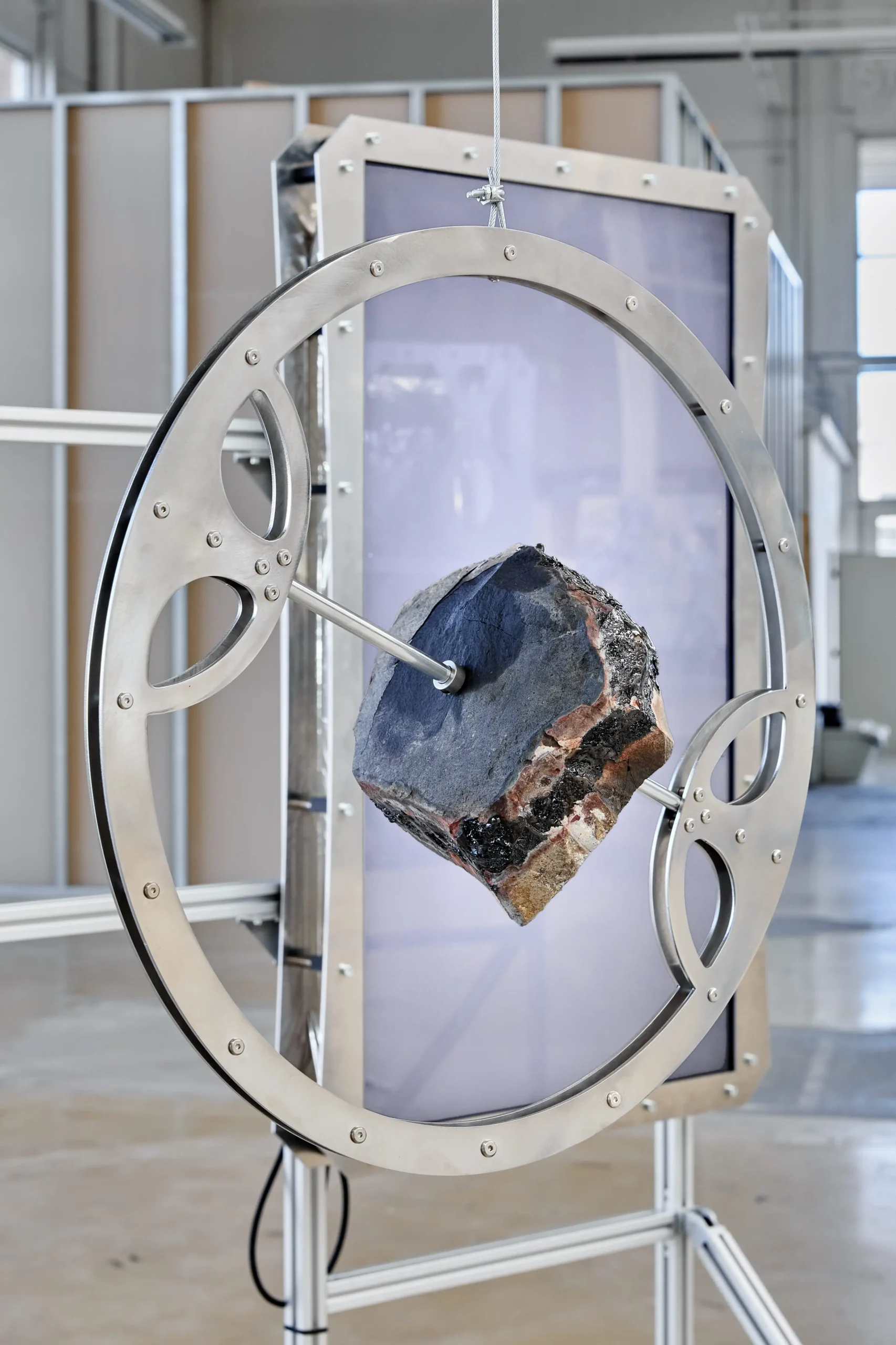
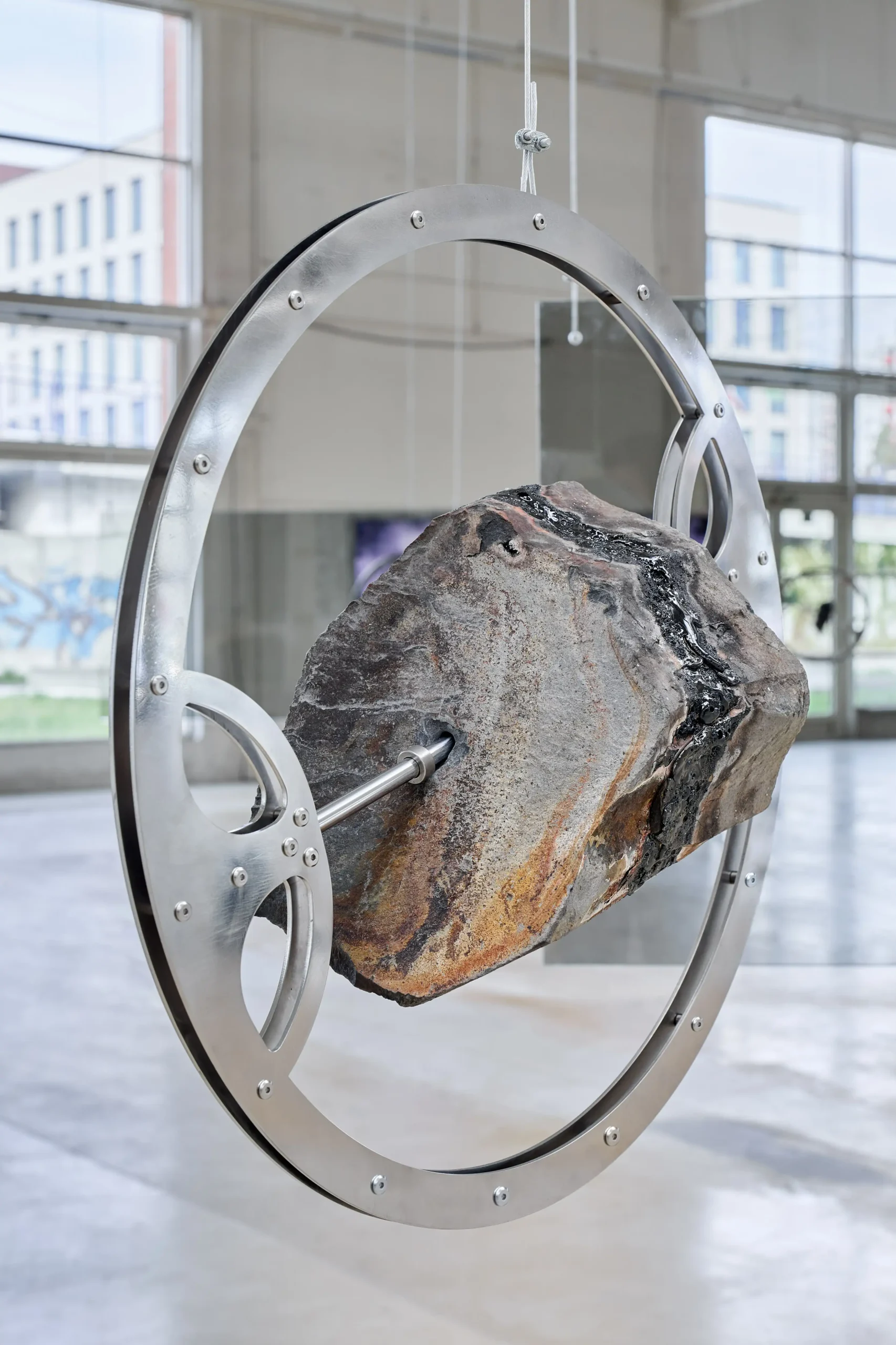
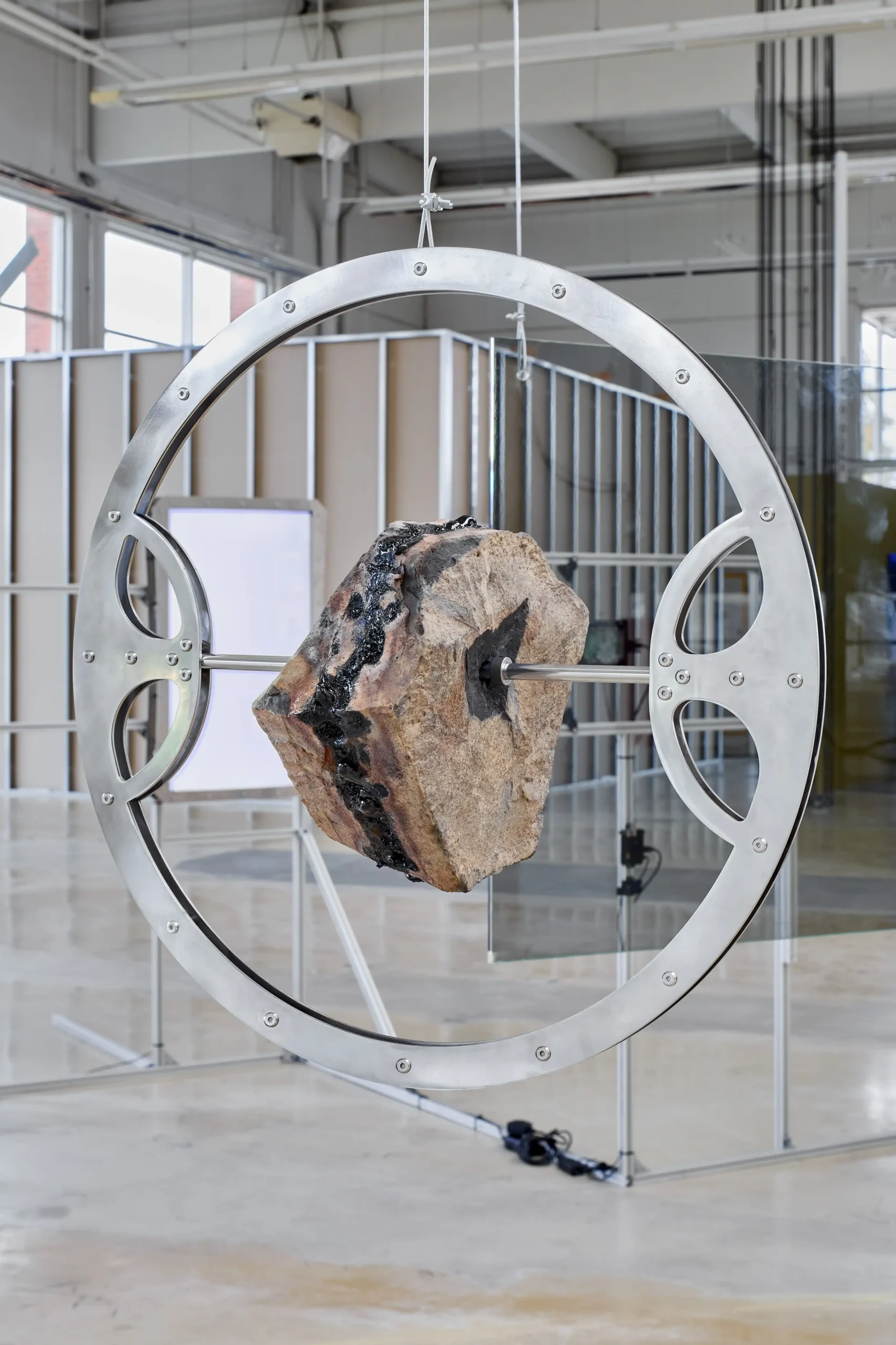
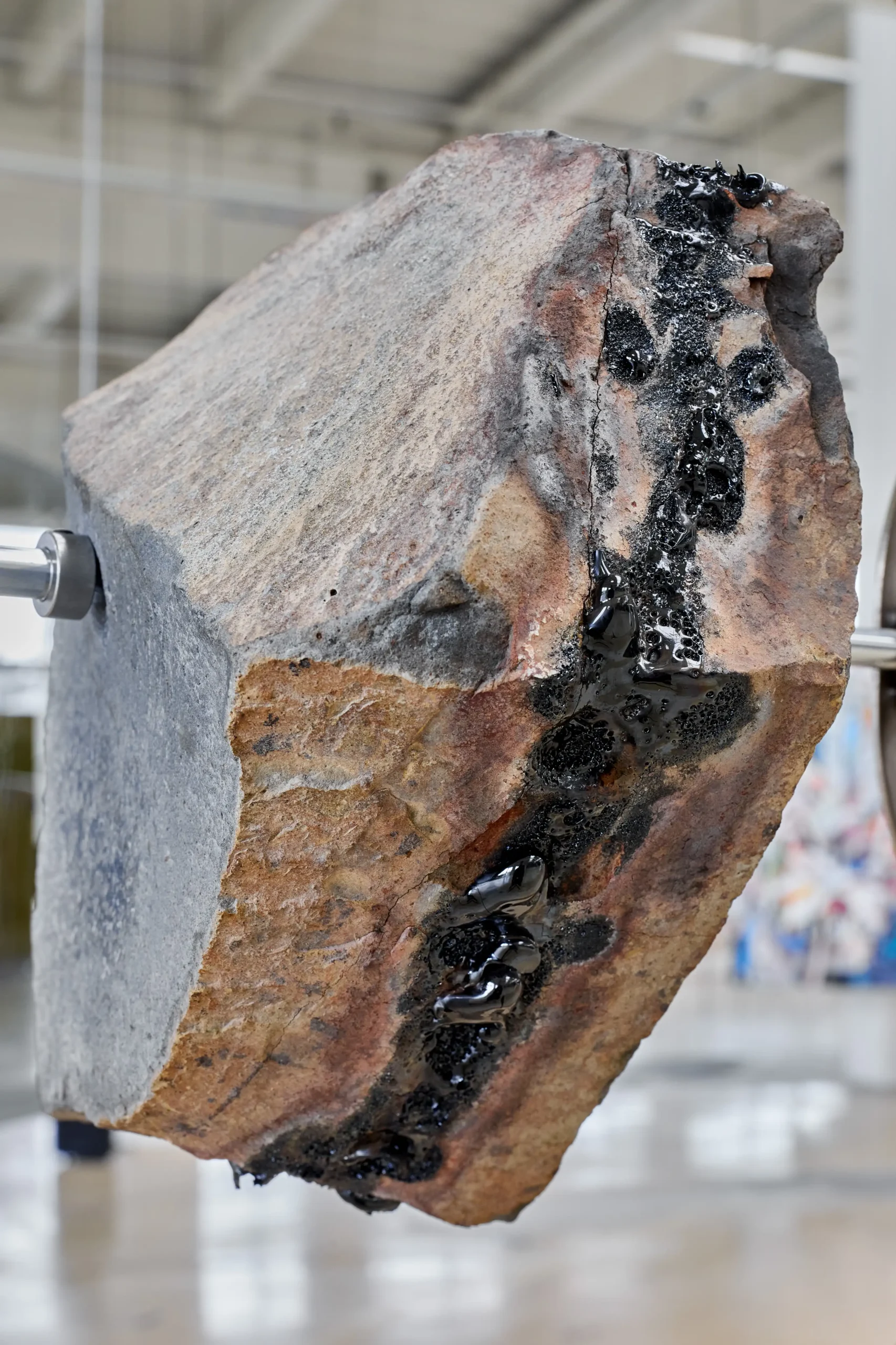
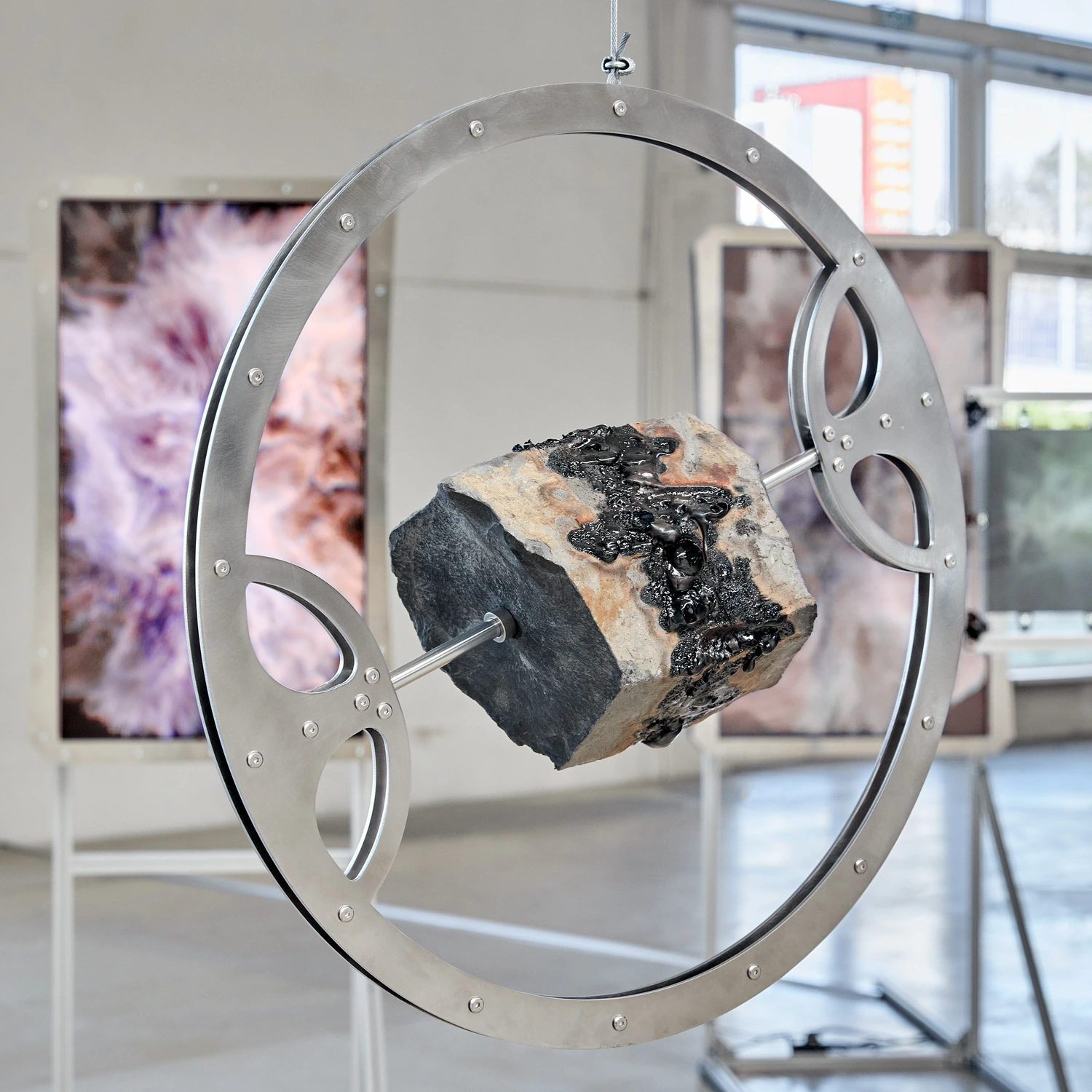
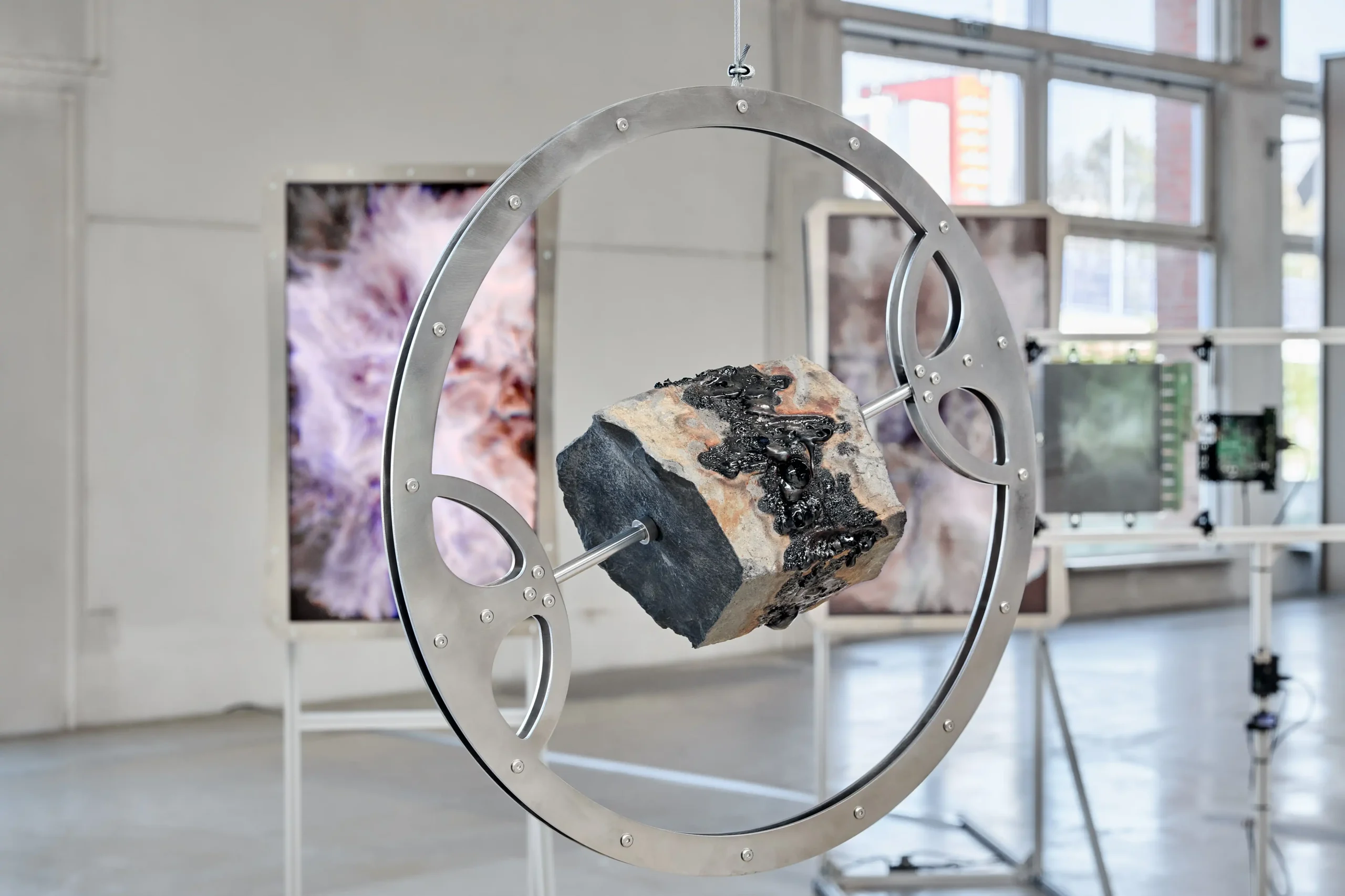
The constellation of objects and screens is complemented by suspended aluminum discs; anchored at their centers are geological specimens that, however, do not appear as though they could be found in nature in this form. They have undergone both technological and natural transformation, but even more so, artistic manipulation via a kinetic mechanism (with the algorithm calibrated to the natural conditions of the site). By setting up a gigantic Fresnel lens that bent and concentrated the direction of a solar beam onto a rock selected by the artist, he executed a new inscription of the memory of those specific natural conditions at that particular time. The works—upon a certain degree of visual revelation—fluctuate in a kind of in-between space: universe, Earth—nature, human, technology. Rather than establishing rigid boundaries, they present fluid variations and combinatorial transitions of perspectives in time and in place.
The distance of observation from space—an expanded perspective of vision that transforms during observation over time—uproots human individuals, communities, and societies from the position of initiators and subsequent controllers of all that happens. Yet the acts of “showing” and “visual scrutiny” in the gallery pull the human observer back in as a reader. The nature of this reader, in a complex fragment, approaches—or has perhaps already entered—a temporal phase of helplessness to effectively intervene. The human, society, seems to be a fragile twig learning to reconcile with its approaching end—a condition Brůha highlights by tracking the activity of other-than-human scales. Sensory experience of such changes over time is a fundamental element of a trend in contemporary global practice—art in the Anthropocene—which turns toward other times: geological time, of which human time is a mere particular interval.
Due to the human aspect (the technological manipulation of human vision) in Brůha’s art, we do not find only a dualistic principle of society versus nature, but a more expansive, albeit temporary, new synthesis. Through the precise use of technologies, Brůha shapes this synthesis into a horizontal connection between human and nature. Through a view of the Earth from orbit, Brůha is able, in a condensed manner, to allow the human senses to catch at least a glimpse of the “hyperobject”—which, according to Timothy Morton, is nonlocal and characterized by omnipresence. It moves beyond the human scale and is definable only through its manifestations, its imprints in objects—among which Morton includes the human who, through their activity, created the hyperobject. Brůha’s work is not merely an imprint but a deliberate concentration that causes a mutability of perception during passage between the elements in the installation. Through their gaze and scrutiny of the elements in the work, the viewer recognizes their own position on a horizontal structure alongside all other objects. These objects are characterized by an inevitable finitude, in contrast to the hyperobject, which has no time of demise in the tangible time of humans.
My work is based on Jan Zálešák’s text Apocalypse Me, Timothy Morton’s book Hyperobjects, and a personal interview with Kryštof Brůha.
GALLERY